 Heater-Cooler
A Brief History of Refrigeration Systems
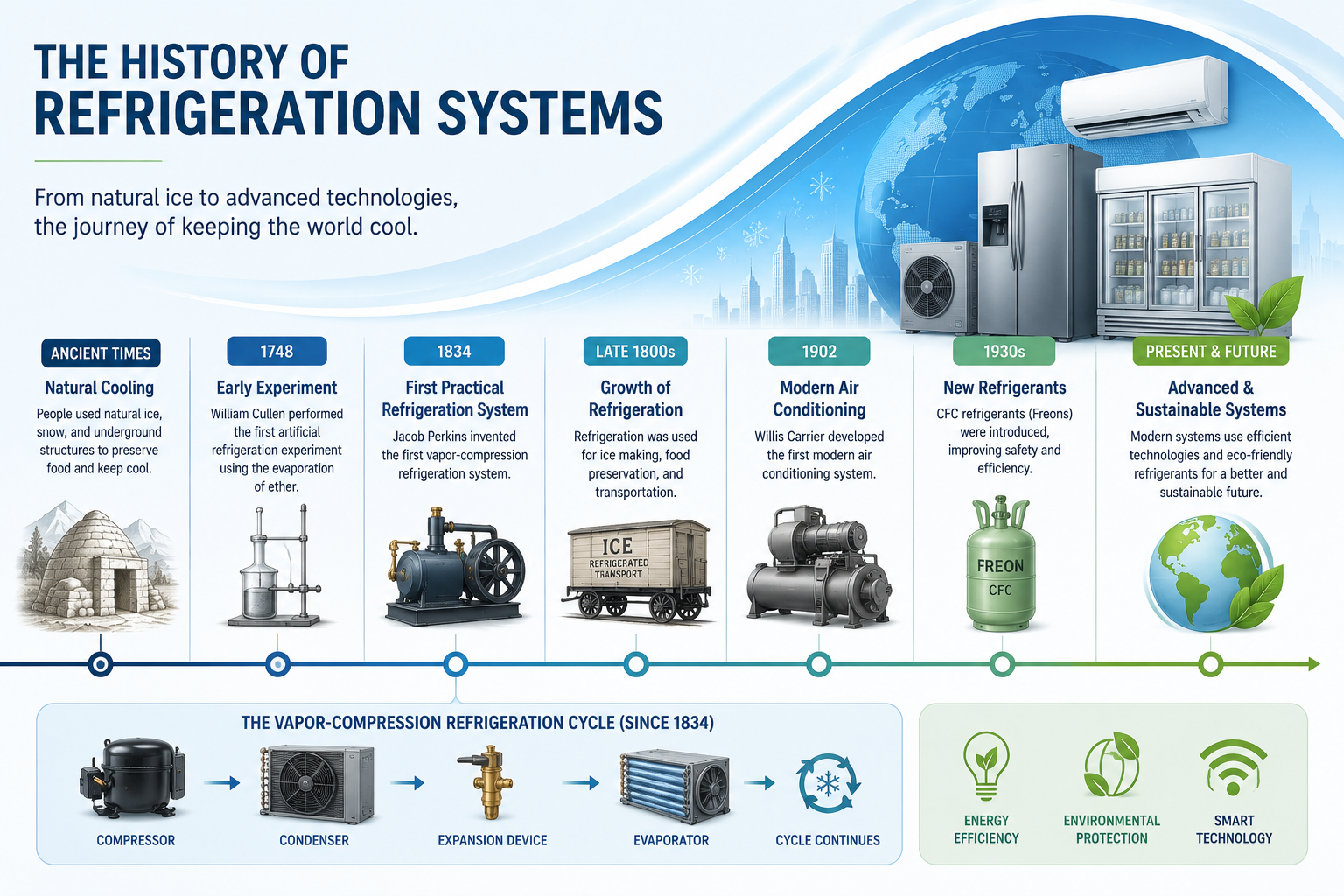
The history of refrigeration dates back thousands of years. In ancient times, people used natural ice, snow, and underground storage areas to keep food cool. In ancient Persia, special structures known as ice houses (Yakhchals) were built to store ice during the hot summer months.
During the eighteenth century, scientists began studying the cooling effects of liquid evaporation. In 1748, Scottish scientist William Cullen performed the first artificial refrigeration experiment, although his device had no practical application.
In 1834, American engineer Jacob Perkins invented the first vapor-compression refrigeration system, which became the foundation of most modern refrigeration systems. His design included the four main components still used today: the compressor, condenser, expansion device, and evaporator.
By the late nineteenth century, refrigeration systems were being used for ice production, food preservation, and the transportation of agricultural products. These developments had a major impact on the food and medical industries.
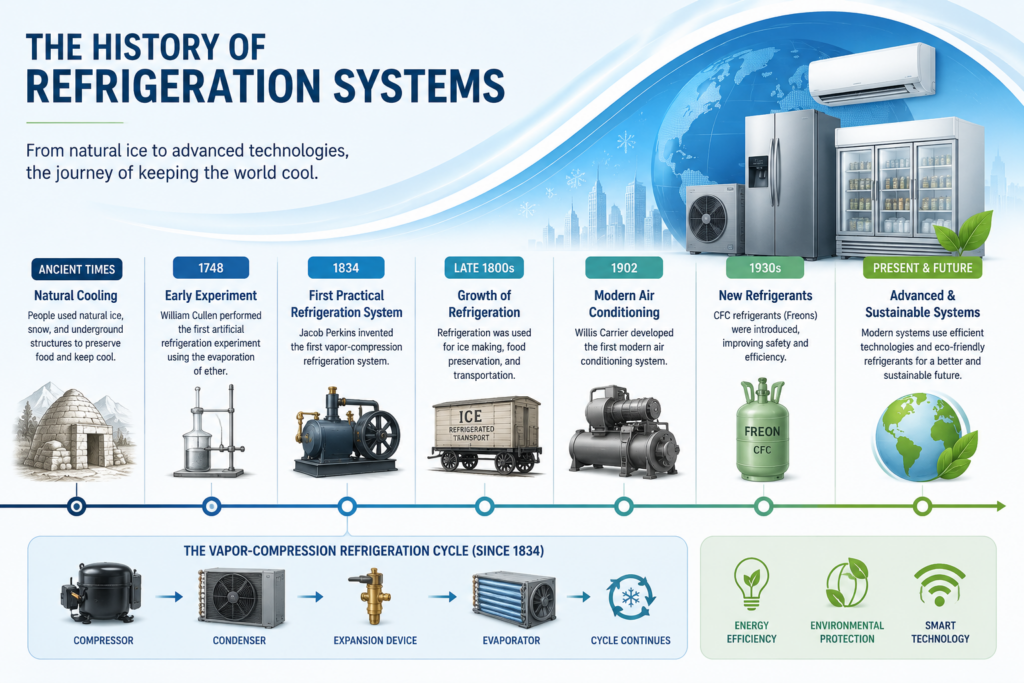
In the early twentieth century, household refrigerators and air-conditioning systems gradually became common. In 1902, American engineer Willis Carrier developed the first modern air-conditioning system, marking a major milestone in the cooling industry.
During the 1930s, new chemical refrigerants known as chlorofluorocarbons (CFCs), commonly called Freons, were introduced. They improved safety and efficiency but were later found to damage the ozone layer. As a result, newer refrigerants such as R-134a, R-410A, and R-32 were developed as more environmentally friendly alternatives.
Today, refrigeration and air-conditioning systems use advanced technologies, energy-efficient compressors, electronic controls, and environmentally responsible refrigerants. These systems are essential in homes, commercial buildings, food processing, healthcare, and many industrial applications. The future of refrigeration is focused on improving energy efficiency and reducing environmental impact.
Comments
Be the first to comment.
Leave a comment